Busbar Analysis
Transient thermal model for an FSAE busbar under continuous current. I wanted the team to see how busbar temperature actually behaves, not just get a steady-state number from a spreadsheet. Energy balance with I²R heating, convection dissipation, and temperature-dependent resistivity, solved both analytically for steady state and numerically for the full transient.
 Open interactive notebook
Open the Colab notebook to change material, current, dimensions, or h-coefficient and re-run.
Theory
Energy Balance
Starting from a control volume on the busbar: heat in from Joule heating, heat out via convection, no flow work, no phase change. That gives us:
Busbar-Specific Form
Key Equations
| Equation | Formula |
|---|---|
| Heat Generation | |
| Convection (dissipation) | |
| Cross-section area | |
| Surface area (cooling) | |
| Temp-dependent resistance | |
| Mass |
Variables
| Symbol | Definition | SI Unit |
|---|---|---|
| Internal heat generation (Joule heating) | W | |
| Convective heat loss | W | |
| Current | A | |
| Electrical resistance (temp-dependent) | Ω | |
| Resistance at reference temperature | Ω | |
| Busbar length, width, height | m | |
| Surface area for cooling | m² | |
| Convective heat transfer coefficient | W/(m²·K) | |
| Busbar, ambient, reference temperatures | °C or K | |
| Temperature coefficient of resistance | 1/°C | |
| Mass | kg | |
| Specific heat capacity | J/(kg·K) |
Simulation Results
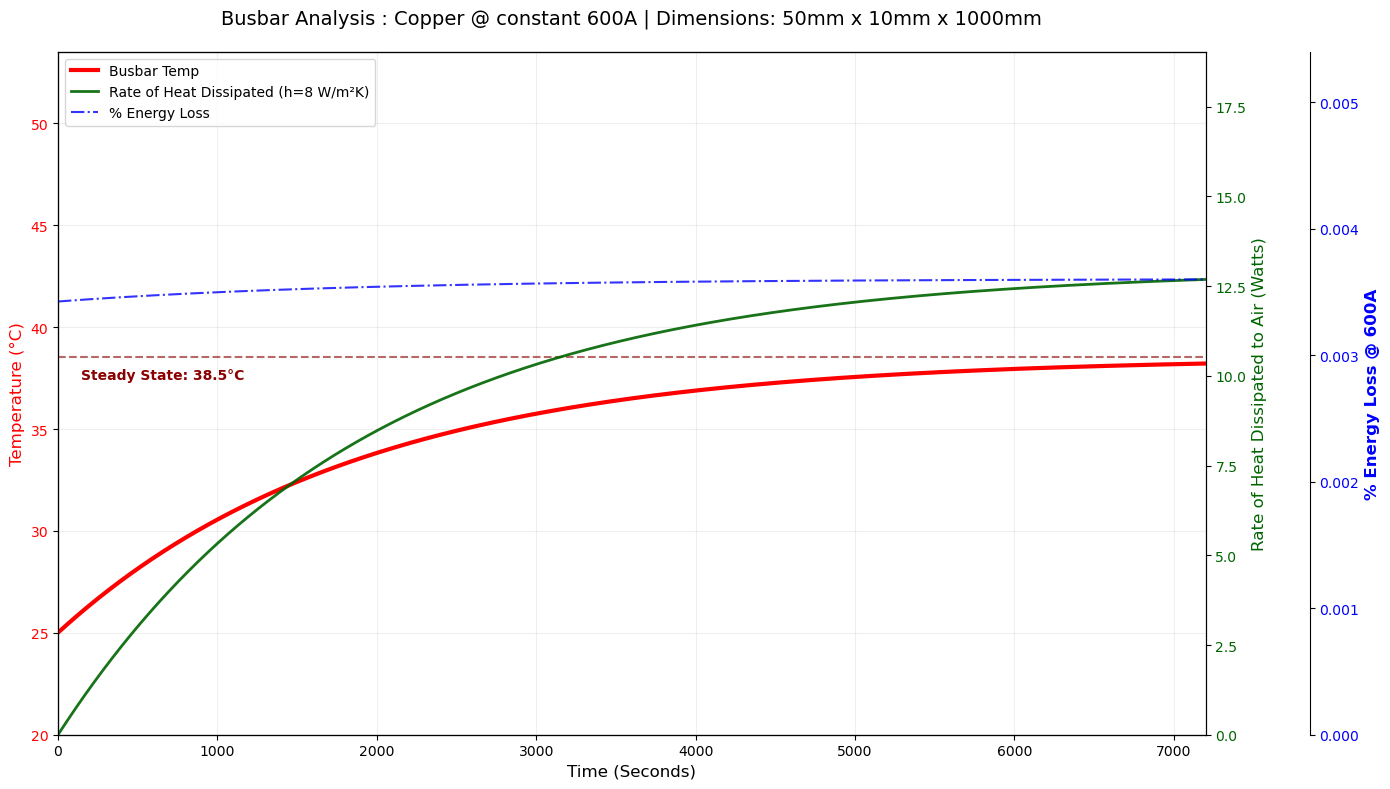
Three metrics over a 2-hour simulation:
- Red: busbar temperature rising to steady state
- Green: rate of heat dissipated to air (convection)
- Blue dashed: percentage of electrical energy lost as heat
Summary
| Parameter | Value |
|---|---|
| Material | Copper |
| Dimensions (W × H × L) | 50 mm × 10 mm × 1000 mm |
| Mass | 4.480 kg |
| Current | 600 A |
| h coefficient | 8 W/m²·K |
| Steady-state temperature | 38.52 °C |
| Final energy loss | 0.0036 % |