Battery Module Structural Analysis

Click "Open in Colab" to experiment with different parameters
These hand calcs translated into a script allowed for quick iteration and structural optimization of our FSAE Battery Segments. The initial version was made back in 2024 (in MATLAB).
This document includes current SES calculations, SES calculations to be introduced in 2026, and calculations deemed to help verify solid mechanical design.
Table of Contents
- Constants and Geometry
- Load Cases & Bending Stress
- Fasteners: Tension, Shear, and Bearing
- Bond Strength Analysis
- Euler-Johnson Buckling Analysis
- Passive Thermal Properties
- Summary Results Table
- Sources Referenced
1. Constants and Geometry
We establish the physical foundations and material properties here.
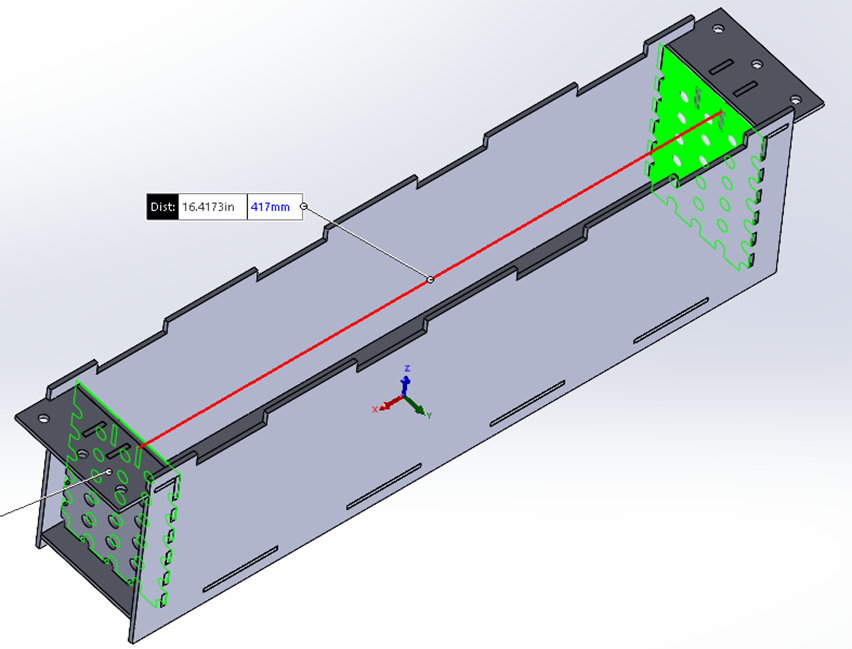
Segment Assembly Diagram
             ____________________________________________________________
            /                                                           /|
           /                     POLYCARBONATE LID                     / |
          /___________________________________________________________/  |
         |                                                           |   | <--EneSegHeight
         |                                                           |   |      (105.6mm)
         |___________________________________________________________|   |
         |                                                           |  /
         |                                                           | / <--EneSegmentWidth
         |___________________________________________________________|/        (81.2mm)
           <------------------- EneSegmentDepth ------------------->
                                 (417.0mm)
Cell Layout (Top View)
         _________________________________________________________
      | | [ o o ]   [ o o ]   [ o o ]   [ o o ]   [ o o ]   [ o o ] |
      | | [ o o ]   [ o o ]   [ o o ]   [ o o ]   [ o o ]   [ o o ] |
      | | [ o o ]   [ o o ]   [ o o ]   [ o o ]   [ o o ]   [ o o ] |  (81.2mm)WIDTH
      | | [ o o ]   [ o o ]   [ o o ]   [ o o ]   [ o o ]           |
      | |_________________________________________________________| |
      |                                                             |
        <---------------------- DEPTH (417.0mm) ------------------->
Input Parameters
| Parameter | Value | Unit |
|---|---|---|
| Module Width | 20.3 | mm |
| Segment Height | 105.6 | mm |
| Module Depth | 69.5 | mm |
| Module Weight | 0.278 | kg |
| Segment Depth | 417.0 | mm |
| Segment Width | 81.2 | mm |
| Garolite Thickness | 3.175 (1/8") | mm |
| Polycarbonate Thickness | 9.525 (3/8") | mm |
| Total Modules | 23 | - |
Material Properties
| Material | Property | Value |
|---|---|---|
| Garolite G10 | Strength | 262 MPa |
| Modulus | 16.5 GPa | |
| Polycarbonate | Flexural Strength | 93 MPa |
| Modulus | 2.21 GPa |
2. Load Cases & Bending Stress
Calculated for 20g vertical and 40g lateral crash loads per SES requirements.
Assuming a uniformly distributed load where total force
Maximum Bending Moment
Bending Stress
Maximum Deflection
Results - Polycarbonate Lid
| Parameter | Value |
|---|---|
| Vertical Force (20g) | 1254.5 N |
| Bending Moment | 65.4 N·m |
| Lid Safety Factor | 1.75 |
Verifies that our polycarbonate lid will survive a 20g vertical crash load - cells will not break the lid or fly out.
3. Fasteners
Tensile Stress Area
For a threaded rod subjected to pure tensile loading, strength is defined by the average of minor and pitch diameters. The tensile-stress area
For ISO metric threads (M6):
Where:
= major/outside diameter (6.0 mm) = thread pitch (1.0 mm)
Axial Tensile Stress:
Ref: Norton, R. L. (2020). Machine Design: An Integrated Approach. 6th ed., p. 907.
Fastener Results (M6 Bolts)
| Load Case | Safety Factor |
|---|---|
| Bolt Tension (20g Vertical) | 39.83 |
| Bolt Plug Shear (20g Vertical) | 23.88 |
| Bolt Shear (40g Horizontal) | 3.32 |
| Bolt Tear-out (40g Horizontal) | 2.65 |
4. Bond Strength Analysis
Given simple loading, how strong is the bonded G10? This does not account for finger joints (which add additional strength).
| Parameter | Value |
|---|---|
| FR4/G10 Bond Strength | 15.2 MPa |
| 40g Horizontal Force | 2509.0 N |
| Bond Safety Factor | 2.80 |
5. Euler-Johnson Buckling Analysis
Euler-Johnson Buckling Criteria
Critical Slenderness and Radius of Gyration:
Johnson (Inelastic) Buckling if
Euler (Elastic) Buckling if
(Ref: Norton, Machine Design, 6th Ed., p. 231)
Results
| Parameter | Value |
|---|---|
| Buckling Mode | Johnson (Inelastic) |
| Buckling Safety Factor | 120.70 |
6. Passive Thermal Properties
Calculating the heat dissipation capacity of the segment casing through conduction.
| Parameter | Value |
|---|---|
| Total Surface Area | 0.156 m² |
| Garolite Conductivity | 0.288 W/m·K |
| Passive Heat Transfer Rate | 14.13 W/K |
7. Summary Results Table
| Section | Load Case | Safety Factor |
|---|---|---|
| 2.4 | Lid - 20g Vertical | 1.75 |
| 3.2 | Bolt Tension - 20g Vertical | 39.83 |
| 3.3 | Bolt Plug-out - 20g Vertical | 23.88 |
| 3.4 | Bolt Shear - 40g Horizontal | 3.32 |
| 3.5 | Bolt Tear-out - 40g Horizontal | 2.65 |
| 4.1 | Bond Strength - 40g Horizontal | 2.80 |
| 5.2 | Casing Buckling - 40g Horizontal | 120.70 |
All safety factors > 1.0 - Structure passes SES crash load requirements.
Code
import math
import pandas as pd

# Conversion Constants
PSI_TO_PA = 6894.76
MM_TO_M = 1/1000
INCH_TO_M = 25.4/1000
G = 9.80665

# 1.1 Module Dimensions
ene_mod_width = 20.3 * MM_TO_M
ene_seg_height = 105.6 * MM_TO_M
ene_mod_depth = 69.5 * MM_TO_M
module_weight = 0.278  # kg

# 1.2 Segment Assembly
ene_segment_depth = 6 * ene_mod_depth
ene_segment_width = ene_mod_width * 4
garolite_thickness = (1/8) * INCH_TO_M
segment_modules_weight = module_weight * 23

# 1.3 Material Properties
garolite_strength = 38000 * PSI_TO_PA
garolite_modulus = 2400000 * PSI_TO_PA
poly_thickness = 3/8 * INCH_TO_M
poly_strength = 93e6  # Pa
poly_modulus = 2.21e9 # Pa

# 2.1 Load Cases
top_force = segment_modules_weight * 20 * G  # 20g vertical
side_force = segment_modules_weight * 40 * G  # 40g lateral

# See full implementation in Colab notebook
Sources Referenced
- Enepaq VTC6 Module Datasheet - Module dimensions and weight specifications.
- Laminated Plastics G-10/FR4 Data - Material strengths, bonding data, and tear-out limits.
- MatWeb Polycarbonate Data - Mechanical properties for the module lid.